
Tungsten vs Lead Jigs: Is Tungsten Better for the Ocean?
Pick up a lead jig and a tungsten jig of the same weight, and the tungsten one is smaller. Nearly everything in the tungsten vs lead debate follows from that. If you jig around Singapore, from the shore or a boat, with 5g to 40g on the line, here's what really changes, and an honest answer to the bigger question underneath.
Denser, not heavier
Pure tungsten is about 1.7 times denser than lead. Tungsten jig alloys are roughly 1.5 to 1.7 times denser than lead, depending on the blend.
"Heavier" is the wrong word: a 20g jig weighs 20g whatever it's made of. What changes is the space it takes up. At the same weight, a tungsten jig has up to about 40% less volume and is roughly 13 to 16% shorter.
Are tungsten jigs better than lead?
Same weight, smaller body, less drag: a tungsten jig gets down faster and is pushed around less by current, other things being equal. Shape, flutter and line drag matter too, and we haven't found a same-weight test that measures the gap, so we won't put a percentage on it.
Tungsten is also far harder than lead, which you can dent with a fingernail. A harder body resists dents better, though how long any jig lasts depends mostly on how often you snag it.
Lead is soft and deadens vibration, which is why it's used for soundproofing. Many anglers report that tungsten feels crisper on the bottom; that's angler experience, not a measurement.
Why are tungsten jigs more expensive?
Lead melts at about 327°C, so it can be poured into a mould. Tungsten melts at about 3,400°C, the highest of any metal, so it has to be pressed from powder and sintered instead. That takes more energy, tooling and time, and it's one reason tungsten jigs cost more.
What lead does in the water
In the World Health Organization's words, "There is no level of exposure to lead that is known to be without harmful effects." Birds that swallow lost lead tackle can be poisoned: this has been documented in more than 30 species, including coastal seabirds overseas. Lost lead also slowly corrodes and releases dissolved lead; a field study in Swedish rivers measured about 1% of the metal dissolving each year. There's little research from tropical waters, so we won't claim more than that for Singapore's.
The UK has banned the sale of small lead angling weights since 1987. Singapore has no rule on lead weights that we could find.
Is tungsten toxic?
Tungsten is lead-free and far less toxic than lead. The US Environmental Protection Agency calls the toxicological information on tungsten limited, so we stop at "far less toxic than lead."
Lead vs tungsten at a glance
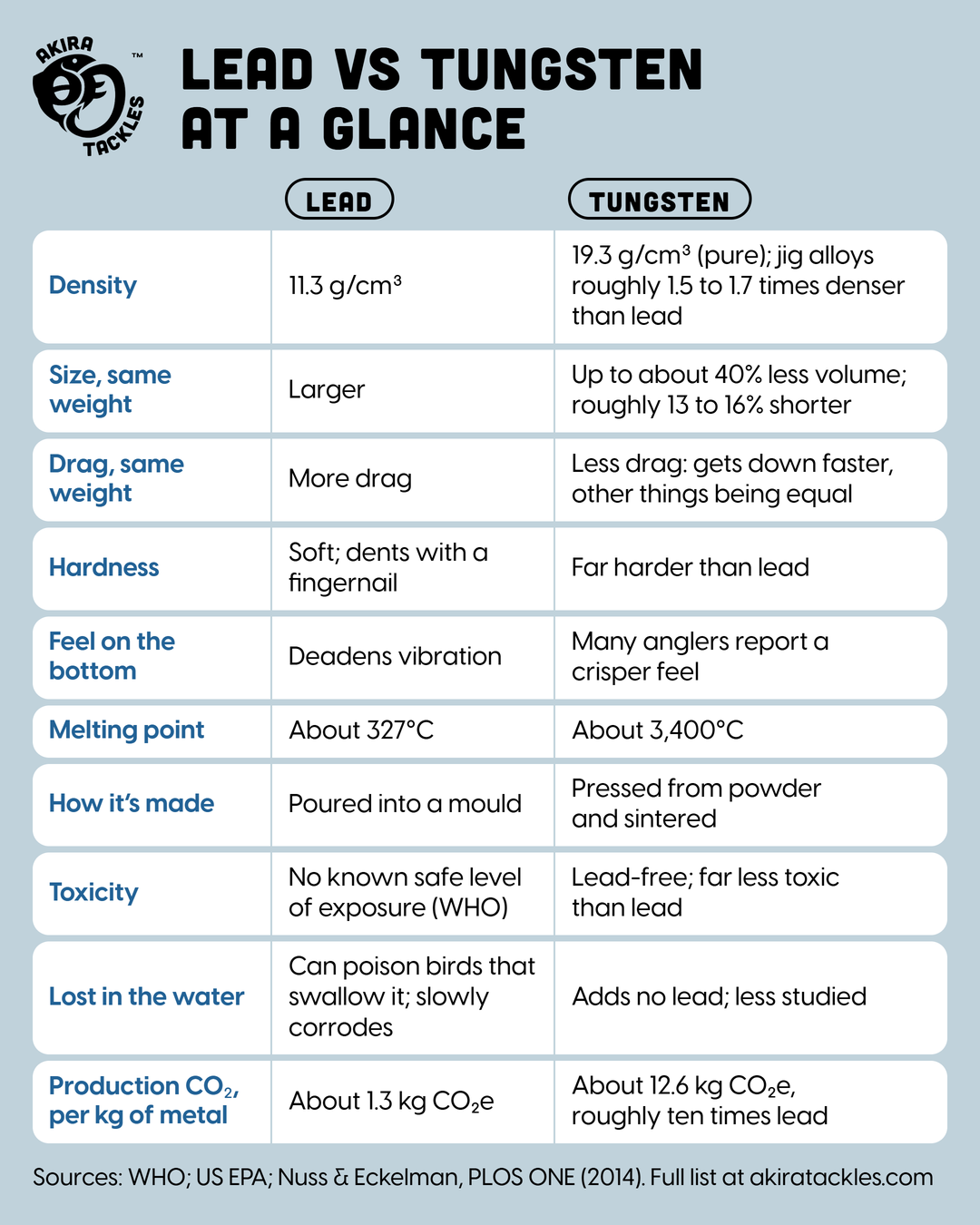
So, is tungsten a much more sustainable lure material than lead?
Here's our honest answer, in two parts. For the water a lost jig lands in, tungsten is better for one specific reason: it replaces lead, so no lead goes in. Tungsten's clearest cost comes earlier, when it's made. Per kilogram, producing tungsten emits roughly ten times the CO2 of producing lead.
So we wouldn't call tungsten "much more sustainable" without qualification. Keeping lead out of the water is the trade we've chosen, and we'd rather name its cost than pretend it's free. Whatever a jig is made of, one lost on a reef is recovered by nobody, so a little care around the snags is worth it.
Our own take is the Prism Jig Tungsten; ask your local stockist for the range.